
Controlled Burns
York Region successfully completed a controlled burn of a tallgrass prairie in the Nobleton Tract of the York Regional Forest located at 5345 15th Sideroad in the Township of King on April 22, 2026.
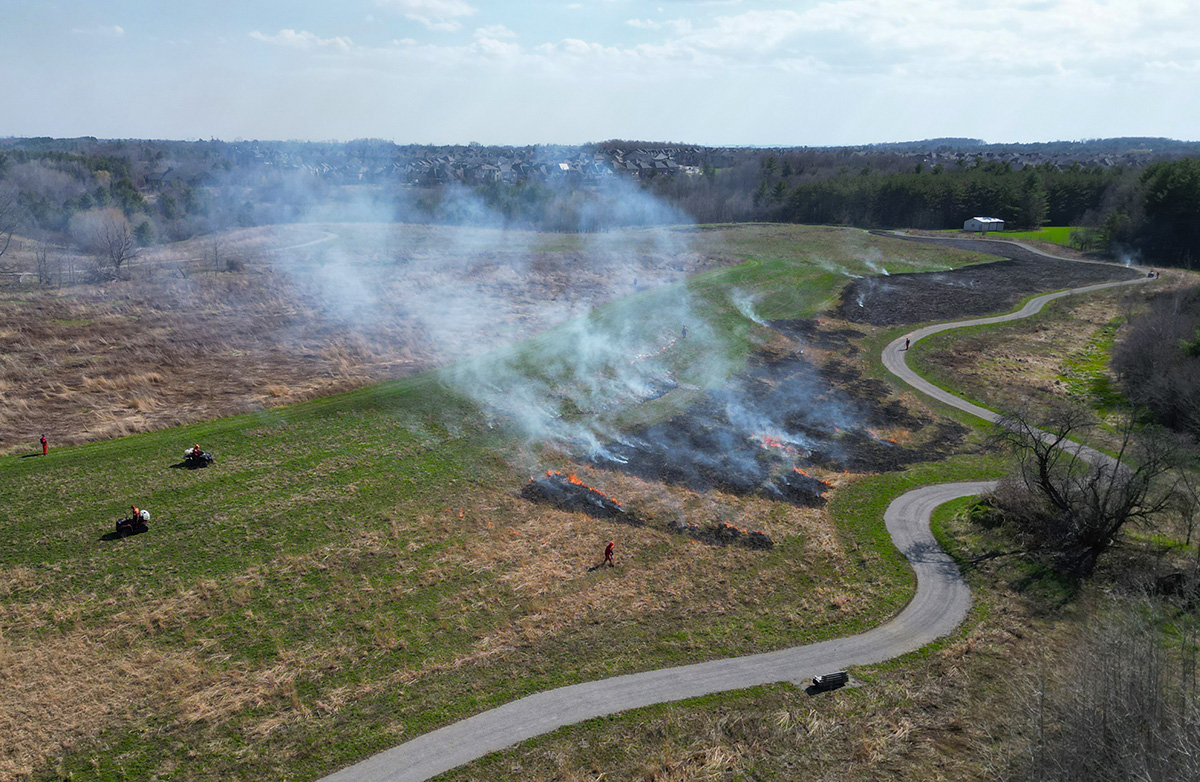
These carefully set and managed fires are an important restoration tool to help maintain and protect tallgrass prairie habitat. The fire burns relatively quickly to consume dried grasses and leaves but does not harm larger trees.
The area that was burned is shaded in red, totalling 6.14 hectares (15 acres), and took two and a half hours to complete.
York Region worked with Tallgrass Ontario to establish this tallgrass prairie which is home to many insects and animals, migratory birds and pollinators. These unique forms of grassland habitat are not only rare in Ontario and globally at risk, but they are also an important part of Ontario’s natural and cultural heritage.
What are controlled burns?
A controlled (prescribed) burn is a deliberately set and carefully controlled fire that burns low to the ground and consumes dried leaves, small twigs and grass stems but does not harm larger trees or wildlife. Historically grasslands were maintained through natural wildfires that swept across the landscape. A controlled burn is designed to mimic the natural fires that once occurred in grasslands. They burn relatively quickly and are lit in such a way that they self-extinguish.
Fire-dependent grassland ecosystems, like tallgrass prairies and oak savannas, contain prairie plants that respond positively to burning and grow more vigorously than they would in the absence of fire. Plants that live in grasslands have deep underground root systems making them both drought and fire resistant.
Every few years a controlled burn is used to protect these valuable grasslands from invasive plants and encourage the growth of valuable grasses and wildflowers which provide food and shelter for a variety of wildlife including birds, bees and butterflies.
The fifth controlled burn of a tallgrass prairie carried out by the Region was on April 22, 2026 at the Nobleton Tract in the Township of King. In the spring of 2018 and 2024, the Region led successful controlled burns of the tallgrass prairie at the Bendor and Graves Tract in the Town of East Gwillimbury, and in April 2022 and 2023, controlled burns were also carried out at the Nobleton Tract.
Why are controlled burns important?
Prior to human settlement wildfires were a natural occurrence, and grasslands including prairies and savannas evolved to be fire dependent. Since grasslands were easier to farm than properties covered in forests, most native grasslands were destroyed by early settlers.
While tallgrass prairies were once common in Ontario, it is estimated that only one per cent of the original (pre-settlement) cover of prairie and oak savanna ecosystems remain in Ontario today, and they are now considered a rare ecosystem.
With habitat destruction and an otherwise fire-adverse society, natural tallgrass prairies and oak savannas have no way of persisting on the landscape if we don’t let fire do its job. Fortunately for these habitats, a controlled burn provides the same effect as a natural wildfire but with minimal risk. Fire stops weedy plants, trees and shrubs from taking over while the fire-resistant grassland species, which store 65% of their energy below ground as roots, are able to regrow.
The York Regional Forest is home to a variety of ecosystems including grasslands and fire is an important management tool used to help maintain these habitats and ensure they continue to flourish. Controlled burns are a part of the long-term management plan to restore and enhance these rare and important ecosystems, and represent the Region’s commitment to supporting biodiversity, pollinators and healthy natural systems.
Importance of pollinators
Pollinators, like the Monarch Butterfly, support our ecosystem that clean the air, stabilize soils, protect from severe weather and support other wildlife by cross pollinating, a process that allows plants to produce vegetables, fruit and seeds needed to create more plants.
It is estimated some 85% of the world’s flowering plants depend on a pollinator to move pollen from the male plant to female plant to produce vegetables, fruits, nuts and seeds. This includes about 35% of the crops people harvest and eat, meaning one out of every three bites of food you eat is there because of a pollinator. Pollination is also required for plants to reproduce, creating a plentiful food supply for the animals that produce dairy and meat.
Visit york.ca/BeesAndButterflies to learn more.
Frequently asked questions
Who is responsible for setting and controlling the fire?
The professional consultant and their crew oversee the technical aspects of setting, controlling and extinguishing the fire. The consultant has experience conducting controlled burns in neighbouring jurisdictions including the City of Toronto, City of Mississauga and Simcoe County.
What precautions are in place to ensure that the burn remains ‘controlled’?
The fire is only lit under suitable site and weather conditions to ensure the wind speed and direction are favourable for the operation.
Staff mow the perimeters of each of the burn locations. These mowed areas (burn breaks) are about two to three tractor-widths wide and are wetted before ignition using all-terrain vehicle (ATV) sprayers with mounted water tanks.
During the burn, the Region’s consultant ignites and controls the pattern of the fire to ensure fire lines are “burning into the black” meaning the fire is headed towards areas already burned so there is no more fuel and the fire self-extinguishes.
The fire is constantly monitored by a team of staff with designated monitoring posts and everyone is in constant radio contact with one another. Multiple all-terrain vehicles (ATV) units are outfitted with water tanks and sprayers, there are also over 1,000 feet of fire hose connected to pumps and water sources on site. Staff from the local fire department are also present during the burn.
Is there smoke from the burn?
The burn temporarily produces large amounts of smoke in the tract and surrounding area. Under ideal weather conditions, smoke rises and does not impact surrounding properties. It is possible however that weather conditions could change and some smoke will linger in the area.
Fire smoke is made up of a mixture of gases and very small particles that are produced when organic matter burns. Exposure to smoke may cause burning eyes, runny nose, irritated throat and sinus, and headache. Children, seniors, pregnant women and those who have underlying medical conditions such as heart or lung conditions may be more sensitive to the effects of smoke.
The impacts from exposure to smoke depend on many factors including weather conditions and proximity to the source. It is recommended that anyone sensitive to smoke stay away from areas with fire smoke. If individuals have trouble breathing or other symptoms, they should consult their healthcare provider. To minimize smoke from potentially entering your home, keep windows, doors and fire dampers closed as a precaution.
How long does a burn usually take?
A burn usually takes a few hours to complete, but exact timing depends on the area to be burned, site and weather conditions.
Why are tallgrass prairies and oak savannas important?
It is estimated only 1% of the original pre-settlement cover of prairie and oak savanna ecosystems remain in Ontario. As a result, many of the plants that grow in tallgrass prairies and oak savanna are listed as rare or endangered in Canada.
Bendor and Graves and Nobleton Tracts are located within the historical range of grasslands that once covered much of southern Ontario. This habitat type is home to many species at risk such as birds like the Bobolink and Meadowlark and can support many important pollinator species of insects including Monarch Butterflies.
Why are controlled burns important for tallgrass prairies and oak savannas?
Prior to human settlement, wildfires were a natural occurrence. Prairies and savannas have evolved to be fire dependent. Controlled burns benefit native plants and animals by removing exotic plants and grasses, restoring wildlife habitat and returning essential nutrients to the soil.
What is the history of controlled burns?
Often referred to as “cultural burning”, Indigenous communities used fire as a management tool to prevent catastrophic wildfires and meet cultural objectives. Cultural burning holds different meanings for different Indigenous communities and represents an important component of land stewardship.
Controlled (prescribed) burns were and continue to be conducted to reduce fuels that trigger wildfires while encouraging new growth and protecting important vegetation. Stimulating land with fire brings balance and is used to achieve certain cultural objectives such as sustaining diverse plant and animal life for food and medicine, promoting important hunting grounds and creating healthy ecosystems to support Indigenous communities. Timing and location of fires are based on the traditional knowledge of their territories passed down from generation to generation.
Sources
Tsilhqot'in Wildfire Management — Gathering Voices Society
Canada needs Indigenous-led fire stewardship, new research finds (ubc.ca)
Cultural Burning - Cultural Burning & Prescribed Fire
How does wildlife survive a fire?
On the day of the burn, staff conduct a sweep of the prairie to deter any wildlife prior to ignition.
Wildlife has adaptive behaviours that help them escape from fire. Mammals, for example, can easily out-run small ground fires or retreat to burrows or previously burned areas. Reptiles and amphibians may remain in the soil, retreat beneath logs and damp leaves, enter burrows or escape to water.
Adult birds can fly away but fires may destroy nests, eggs and hatchlings. That is why staff have chosen windows of time where the site will have the least wildlife activity. This includes respecting the breeding bird window for this area of the province. Should the burn window encroach into the breeding bird window, a biologist will conduct a breeding bird and nest survey prior to burn commencement. Should any nests be discovered, the area surrounding the nests will not be burned.
Overall, most animals benefit from the new growth that follows a fire and the open type of habitat it maintains. Some animals such as quail, turkey, coyote and birds of prey will move to recently burned areas looking for food.
How do you determine the success of the burn?
The success of the burn is determined by York Region’s Forestry Services who are trained in ecosystem management alongside tallgrass specialists and the hired professional consultant. Staff monitor burned areas over many years and determine the positive and negative impacts on the different plant species.
The desired effect is to see greater populations of prairie plants, while at the same time seeing reduced growth and decreased presence of invasive and undesirable plant species. Additionally, breeding bird surveys are conducted before and after the burn and the observation of grassland bird species using the site is also considered a measure of success.